
PP131
The Myth of Passive Income in Real Estate Investing
“I’d like to make a quick announcement,” someone half-yelled from the other side of the crowded hotel ballroom.
It was my first monthly meeting of the Georgia Real Estate Investors Association. I’d decided real estate was my road to wealth and passive income, and I wanted to be around and learn from investors who were already living it.
The man with the announcement stood and waited for the room. Late 50s, beard and glasses, a bright white pocket protector in his plaid shirt.
“I just bought my 35th rental house, and now have enough passive income to finally quit my job!”
I’d talked with him during the networking time before the meeting. He hadn’t mentioned a number, but he did tell me he self-managed his whole portfolio, handling everything from screening tenants to unclogging toilets, spread from South Atlanta to Chattanooga.
I sat there with a thousand-yard stare while questions rapid-fired in my head. How small was each house’s cash flow that it took 35 of them to cover his living expenses? How much time does he spend in his car every day?
He was celebrating quitting one full-time job, but was completely oblivious that he’d built himself a different one.
I tell this story often because it shows the real risk of blindly chasing “passive income”: a massive mismatch between your vision and the reality you end up living.
Every path to real estate income comes with a job description, but most people fail to read it before committing to the role.
Landlording is a job with unpredictable hours
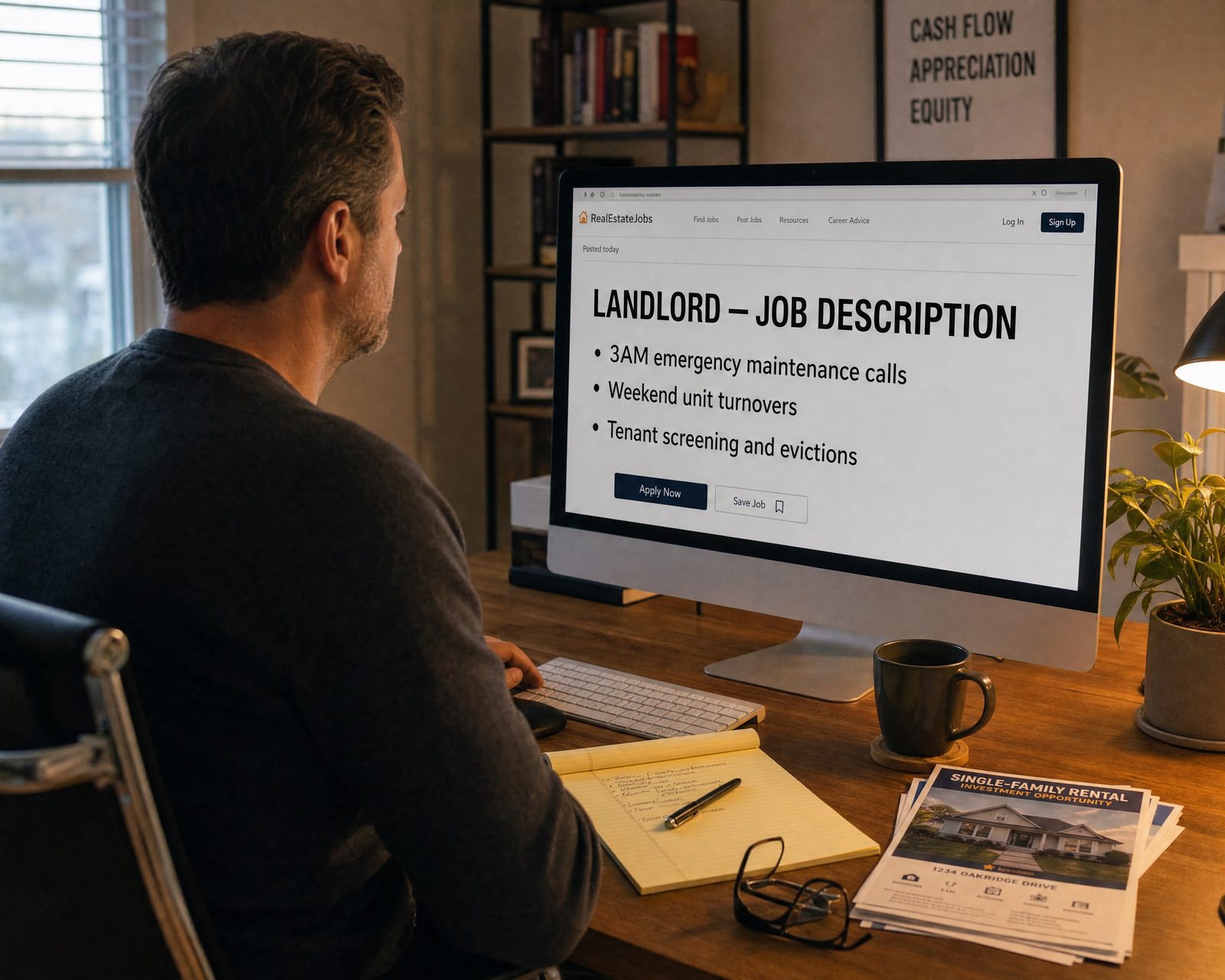
For most people new to the space, “passive income through real estate” looks like buying single-family homes and becoming a landlord (like our friend from the REIA meeting). And while that’s probably the most widespread version of real estate investing, it’s far from passive.
Your phone rings at 3am because a toilet clogged, turnovers and regular maintenance eat your weekends, and one surprise HVAC replacement can erase a year’s worth of returns.
“Hire a property manager!” people will say. That helps, no doubt – they handle the calls, the showings, the basic repairs.
But what they can’t do is take the decisions off your plate. You still make every repair go/no-go decision. When a tenant stops paying, deciding whether to evict is yours. And the legal exposure stays with you if something goes sideways.
You’ve moved from doing the work to overseeing whoever does the work. It might be slightly more passive, but it’s still a job.
In a syndication, the work moves up front
In a syndication, a professional operator runs the deal, and day-to-day operations (and decisions) genuinely leave your plate.
The investing work that remains is picking the sponsor and the deal. It might not be manual labor like unclogging a toilet, but it’s still serious work. And unlike landlording, the work is one-time per investment and is significantly front-loaded.
Before you wire a penny, you’re vetting the sponsor and pressure-testing the deal, deciding whether these are people you’d trust with your capital for potentially a decade or more.
But even the passive end has a job description
Say you invest passively in a real estate syndication and distributions start arriving. You still have a role:
- Quarterly reports show up (they deserve an actual read)
- Sponsors keep pitching new deals (each one needs a yes or no)
- Tax season brings a K-1 from every deal (you’re the one chasing the missing ones)
It adds up to a few hours here and there, nothing close to a second job. But assume the role is zero and you’ll be frustrated the first time a K-1 runs late or a capital call lands in your inbox.
The income is passive. The investor isn’t.
I think often about the guy with the pocket protector. He called it passive income, but everything he’d told me before the meeting said otherwise.
There was nothing inherently wrong with his path. If driving between Atlanta and Chattanooga to handle whatever broke that morning is how he wants to spend his days, he built exactly the portfolio he needed.
It’s only wrong when the dream and the reality don’t match.
Most often that looks like an investor who expected cash flow from a beach chair and instead ends up holding a plunger. But it runs the other way too: someone who actually wants to be highly hands-on would be miserable as a limited partner who has little control in a deal.
Either way, there’s work involved. And that work either fits the life you’re trying to build or it doesn’t – that’s why you read the job description before you take the job.
Found this valuable? Join hundreds of sophisticated investors and receive these insights direct to your inbox every week.